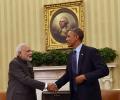
Furthering Indo-US cooperation on terrorism, Prime Minister Narendra Modi and President Barack Obama on Tuesday agreed to make "joint and concerted efforts" to dismantle safe havens for terror and criminal networks like Lashkar-e-Tayib, Jaish-e-Mohammad, Dawood-company, Al Qaeda and the Haqqani network.

Prime Minister Narendra Modi on Tuesday sought unity among Asian countries and said they must work as Asians to shape the world and reform the global institutions of governance, including the United Nations.

There are still a few lingering issues towards the progress of India-China bilateral relations, the approach for dealing with each other seems to be quite different. With Modi-Xi bonhomie strengthening, it seems that India and China are ready to recalibrate their approaches towards each other, says Sana Hashmi.
'Karpoori Thakur must be remembered by people today who are tired of witnessing fractious politics where corruption, bigotry, hatred and violence seems to have become distressingly recurrent,' says Mohammad Sajjad.

'It was China's rise that caused the New Cold War in Asia as it prompted the United States to rebalance its forces in Asia to experiment with engagement and containment at the same time,' says T P Sreenivasan.

The two countries also asked all nations to stop cross-border movement of terrorists and asserted that a decisive collective response from the international community without 'double standards and selectivity' was required to combat the threat of terrorism.
'The attack on the Pathankot base constituted an act of war. Yet Modi's only public comment up until now on that attack has been to blame it on "enemies of humanity".' 'Modi came to power talking tough about Pakistan. But in office, he has pursued a Pakistan policy that has lost both direction and purpose,' argues Brahma Chellaney.

India is no longer shying away from playing a role on the regional and international stages and is willing to don a bigger role in regional politics. It is showing traits of a responsible stakeholder in the regional security dynamics, says Dr Rahul Mishra.

'Obama probably thinks, "He is quite a guy!" Americans on Capitol Hill think, "He has guts. He is a big player".' An Indian official explains the importance of the Modi visit to Sheela Bhatt/Rediff.com
Separatists and their wide network must be neutralized for peace in the Valley

Calling India an indispensable partner for the 21st century, United States Secretary of State John Kerry said on Monday the dynamism and entrepreneurial spirit of this bilateral relationship is needed to solve some of world's greatest challenges.

Narendra Modi's positive engagement with Barack Obama has well and truly washed away the doubts and slights of the past.

The US intends to break up India's strategic partnership with Russia and to continue to interfere in Indian-Iranian relations, apart from inserting itself into the Sino-Indian bilateral discourse, says Ambassador M K Bhadrakumar, analysing the US defence secretary's visit to India.

The disappointment of the year is government's failure in finalising the re-drafted aviation policy.

India on Monday did some plain-speaking with China over its blocking of the Indian bid to get JeM chief Masood Azhar banned by the UN and warned the global community of "serious consequences" if it continues to adopt "double standards" in dealing with terrorism.

'This arrest was totally unnecessary and disproportionate to the gravity of charges. What was truly required was a more measured and calculated approach, keeping in mind the strain such an action could cause to the growing bilateral relationship between these two great nations.' Indian-American organisations condemn Indian diplomat Devyani Khobragade's arrest.

The Deen Bachao, Desh Bachao conference in Patna on April 15 was attended by lakhs of Muslims. Will the electoral dividends from this rally be reaped by Nitish Kumar, the BJP (through Hindu consolidation), by both Nitish and the BJP or will it be reaped more by the anti-BJP forces, asks Mohammad Sajjad.
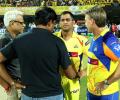
Sadly, the Lodha panel verdict on the IPL spot-fixing scandal of 2013 can't guarantee such incidents won't happen in the future, says Bikash Mohapatra/Rediff.com.

President Pranab Mukherjee on Monday addressed the first joint sitting of Parliament as mandatorily required under the Constitution after the general elections. The address is the political, economic and foreign policy road map of the Narendra Modi government and covers virtually all crucial areas.

'There is tension between the zones all the time.'

The main culprit in vitiating the inter community/caste/class relations has been the so called 'targeted' approach. This is nothing but discrimination on the basis of faith/caste/class. When an equally poor and deprived child is denied scholarship, despite equal merit, resentment begins to brew, says Colonel (retd) Anil Athale.

A summary of sports events and persons who made news on Saturday
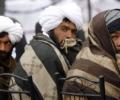
The two countries that will be most affected by the internal developments in Pakistan are India and the United States, says Bob Blackwill. Aziz Haniffa reports

Modi also made a call for European Union unity and said India would play a positive role in enhancing that through Germany.
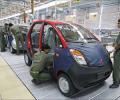
With an aim of boosting manufacturing and exports amid sharp fall in the rupee, the government has decided to take a slew of steps, including enhancing steel production capacity to 300 million tonnes and raising textile exports by 30 per cent this year.
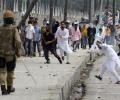
'There is a problem with the rise of a popular view that sees Kashmir through the prism of the larger, chronic Hindu-Muslim tensions.' 'By redefining the Kashmir problem simplistically in Hindu-Muslim terms could end up keeping Kashmir but losing most Kashmiris,' says Shekhar Gupta.

Budget proposals have set four goals to transform Indian Railways.

'If the RSS should be saluted for choosing such a scholarly statesman to address its highly trained cadre, one must also praise Pranab Da's sagacity for having gracefully accepting the invitation, thus disapproving any ideological apartheid,' says former BJP MP Tarun Vijay.

The government has provided a long-term vision.

'The government has belied the hope that many harboured of change, efficiency and dismantling old practices as the defence ministry continues to pursue the same well trodden and wasteful path.'

'Fearlessness, courtesy, humour, wide interests and wisdom, deep commitment to science and technology, passion for the environment, objectivity and the ability to see many things through not only a national but also an international prism.'

Imagine being a part of a country, but being discriminated against by the majority community and atrocities being committed against you by the state. This is the deplorable conditions that the Rohingyas of Myanmar live in where they are cut off from their livelihoods and sources of income, unable to access markets, hospitals and schools, and have little or no access to relief aid. In order to understand the situation and the genesis of the tragedy unfolding, Rediff.com's Archana Masih speaks to Ambassador Vijay Nambiar, the United Nations' Chef de Cabinet (Chief of Staff), who had served a long stint with the UN in New York on the issue.

All those of us who care about books should welcome the appointment, as head of the Indian Council of Historical Research, of Yellapragada Sudarshan Rao. This is not because Rao has so far distinguished himself as a writer about "history and tourism management", which is the department of Kakatiya University in Warangal he headed before retiring to head an Rashtriya Swayamsevak Sangh-backed project to "write history from a nationalist perspective and popularise Sanskrit", two aims which naturally go together for the RSS.

How will the return of a majority government at the Centre, the new India-US friendship and the Mangalyaan triumph change India?
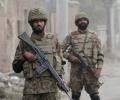
India must watch for signs after Peshawar that Pakistan is waking up to the dangers of Islamism, muses Ajai Shukla
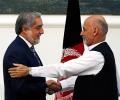
As Ashraf Ghani and Abdullah Abdullah form a joint government after contesting the presidential election against each other, Prakash Bhandari reports from Kabul on the problems facing the new, US-brokered arrangement.
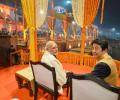
'Modi and Abe are working seriously for India-Japan bonhomie to grow stronger.' 'It is a win-win situation for both countries and the future look promising,' says Rajaram Panda, the Indian Council for Cultural Relations India Chair Visiting Professor at Reitaku University, Japan.

If Indian PM boycotts the CHOGM, it is likely to add to Sri Lanka's bitterness. This would not help India's desire to add more depth and content to its relations with Sri Lanka but its ability to influence Sri Lanka's decision making process on the both strategic issues and on Tamil minority issues, says Colonel (retd) R Hariharan.

The government must justify why we need to buy foreign reactors when we have developed up to 700 MWe unit-size pressurised heavy water reactors, a design which can be easily extended to 900 to 1000 MWe unit size. Why can't the 'Make in India' philosophy apply to indigenous nuclear reactors, more than 18 of which have been designed, built, and being operated by Indian engineers, asks Dr A Gopalakrishnan.

'The real test will be in defence-related deals, for instance the Javelin anti-tank missile: Is the US willing to co-develop something with India, on terms that will support the 'Make in India' initiative? Is there defence technology transfer? Or will it dump old junk on India?' asks Rajeev Srinivasan.
 © 2026 Rediff.com - Advertise with us - Disclaimer - Privacy Policy - Sitemap - Feedback - About us - Terms of use - Grievances